CW for discussion of sexual abuse and violence, and for therapist self disclosure
In my last blog, I pointed out a study that shows trans girls are a staggering 149% more likely to be sexually assaulted in schools that exclude them from girls’ bathrooms and locker rooms than in inclusive schools, a US study (Murchison et al 2019)1 of high school students found. This study also showed that all trans teens experience elevated levels of sexual assault, a fact corroborated by many other studies (see Galop for UK data). The lack of concern over trans girls’ safety, of course, exacerbates trans girls’ lack of safety.
In this blog, and my upcoming CPD day in September, I want us as therapists to rethink the risk factors of abuse, what makes a person unsafe and what safeguarding might look like in a just world. I’ll make this argument from a feminist, anti-oppressive perspective. Recognising that all manner of social inequalities and power structures contribute to the conditions that enable abuse makes our analysis less two dimensional. I’ll be focussing on LGBTQA+ and disabled victims as this is my specialism, but also because I believe we especially need to pay attention to who society cares less about, because those are inevitably going to be the people who will be most easily abused.
Background to my work
I’ve worked with survivors for two decades in various contexts; two Women’s Aid organisations, one trans woman inclusive, one not; a sexual violence service working with all genders; a service for male domestic violence victims; as a school counsellor working with abused children; more recently in private practice, working with LGBTQA+, disabled and neurodivergent people. I’m also a survivor of abuse myself.
I’ve learned three hard truths relevant to this article. The first is that women are as capable of perpetration as men when they find themselves in positions of undue relational or social power; it doesn’t happen as often, but it isn’t nearly as rare as some people paint it, nor is it some kind of “lesser” abuse. The second is that marginalisation, isolation, and inequities such as vulnerable housing and lack of social or parental support make it easier for perpetrators to target someone. The third is that being a survivor of abuse is in and of itself so excessively stigmatised in our culture, including by the therapy profession, that it makes a person even more at risk of further abuse.
When I studied domestic violence in more detail during my Masters in Trauma Studies back in 2013 it clarified for me that abuse was not in fact about who had which body parts, but about structural inequalities—how people can be isolated, made into legitimate targets, turned into lightning rods for social tensions, and above all not listened to or believed when they are abused and after.
Yes, there is an overlap
Admitting to being a survivor within this profession still carries a heavy risk, not least as an autistic, ADHD trans person, where wrong-headed theorists still misunderstand the population overlaps.
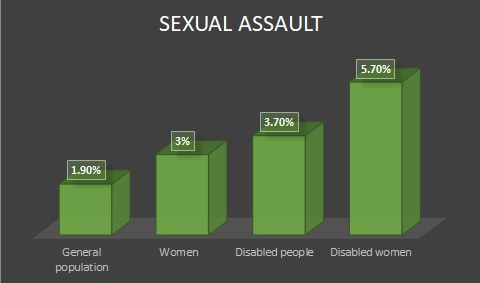
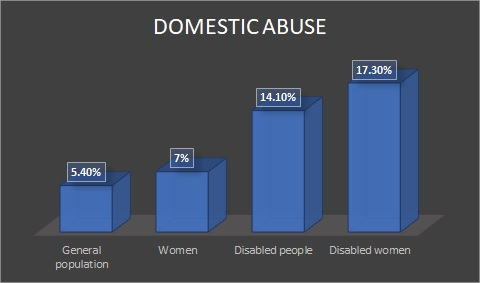
I’ll spell it out clearly, as the study above and so many others should make perfectly clear: the reason so many LGBTQA+ and neurodivergent people have an abuse history is not because abuse causes queerness or neurodivergence, but because abusers target queerness and neurodivergence, as they target physically disabled people also (see graphs for ONS statistics2 below on this point) and other marginalised folks such as children in care. A study of violence against autistic people (Douglas & Sedgewick 2023) finds elevated levels of victimisation across all genders, but across multiple studies autistic cis women fare worse and trans autistic people worse still. This study lists many systemic factors related to how society treats autistic people and trans people that render victims at greater risk of abuse.
The following graphs show the ONS statistics on domestic abuse and sexual assault for disabled people.
A feminist+ model
I’ve worked with many, many survivors, and they all had in common that their abuser held power over them—as a mother, an older sister, a friend, a partner, a teacher, a doctor, a care home worker, a police officer, a mentor. Rarely a stranger. Abusers can come from any demographic, and many abusers are children themselves, but still holders of power over their victims, even if simply by virtue of their target being seen as the “weird” kid who doesn’t yet know they’ll grow up to understand themselves as queer and neurodivergent but everyone knows is different.
Many other inequalities can be at work that I’ve not focused on here—racism, age disparity, social power, social capital, institutional power, and the “keep it within the community” injunction that ensures the silencing of victims within families or communities that feel they have to keep their ranks closed for safety.
None of this is to downplay the horrific toll of violence against women, but I’m interested in how we do that while highlighting the overall mechanisms of abuse.
If we erase the idea of built power structures that can be dismantled in favour of the idea of male supremacy as biological inheritance, men are imagined as predisposed towards dominance and violence, sexual or otherwise. This can lead us to stop thinking about who holds genuine social power when we want to challenge abuse culture, which leads into talking about migrants and boy children’s abusive potential rather than the roles of, say, leaders or institutions.
This draws our eyes away from the ways in which perpetration is used to create systems of power and how an underclass of more abusable people are trafficked through those systems. And that’s why I’d like to once again call the reader’s attention to the fact that one of Epstein’s early accusers was a trans girl, Ava Cordero4, and note that the victims of grooming rings I’ve worked with were not chosen at random, but were particular young people who society chooses not to listen to or care about, sometimes the very kids and young adults we imagine as being a danger or a problem rather than in danger.
Justice focused safeguarding
I’d like to go back in time to the origins of the #metoo movement; Black women creating a community of care for survivors5, a focus that can quickly get lost. It seems we need to keep reminding ourselves to care about the actual people who experience abuse. We need to attend to how hard it is to listen to victims, to believe victims, and keep improving. Especially ones who are folks who get less listened to by design. Especially victims that have already told us several other things about themselves that are very different from the norm and already stretched our credulity. Especially victims who seem like they might be “attention seekers”. Especially victims from demographics that our far from neutral culture has groomed us to think of as sexual deviants or predators. Especially victims who can’t speak or struggle to make words or communicate well. Especially victims who are “difficult”, “badly behaved”, “loud”, “abrasive”, “unlikeable”.
Perpetrators are highly skilled at picking victims who will not easily elicit empathy, so effort needs to be made to focus our empathy where it does not naturally want to go. And perpetrators are also good at grooming the people around their victims, and they do this individually and collectively.
I wonder if our professional gaze on victims needs to entirely shift? Much that was once seen as pathological in our clients turns out to be pre-existing quirkiness that abusers honed in on. Through my career I’ve heard autism, queerness, asexuality, kinkiness, ADHD and transness pathologised erroneously as trauma symptoms too many times, and we’re a long way from done with this bad habit. But this means we’re primed to mistrust the experience of those most likely to be abused, and to assist them to mistrust their own sense-making, which is mighty convenient for those who want to victimise them.
What if we took a breath, stepped back, and admitted we don’t know what it would look like for survivors of abuse to simply be treated with belief, kindness and acceptance, not constantly told they need to change and be fixed? Or that they are walking problems to solve in a very pointed way that we do not apply to any other difficult life experience? We speak about the need for psychological safety but I wonder how much collective social responsibility we take to create it for survivors?
The greatest healing there is, I truly believe, is to hold this truth for clients; “you are not broken. It’s not you that’s deeply ‘fucked up’, it’s what’s happened to you, the context it happened in, and the lack of kindness, belief and respect you are being given”.
We have so much work to do to improve the way we view the kinds of survivors I see in my therapy room. There’s a huge empathy deficit here, an insertion of tired old theories and tabloid talking points as impenetrable barriers between client and counsellor. At the very baseline of competence in this area, we should not be practising any kind of conversion therapy or even subtle undermining of someone who has already had their sense of self eroded and undermined through their experiences of abuse. Justice means championing client’s bodily autonomy, self-determination, and their right to be as quirky as they naturally need to be.
Sam will be running a CPD day on this topic in September.
1. Murchison, G., Agénor, M., Reisner, S.,Watson, R. (2019) School Restroom and Locker Room Restrictions and Sexual Assault Risk Among Transgender Youth. Pediatrics; 143 (6). doi: e20182902. 10.1542/peds.2018-2902
2. Office for National Statistics (2019) Disability and Crime, UK: 2019. At: https://www.ons.gov.uk/peoplepopulationandcommunity/healthandsocialcare/disability/bulletins/disabilityandcrimeuk/2019
3. Douglas, S., & Sedgewick, F. (2023) Experiences of interpersonal victimization and abuse among autistic people. Autism; 28(7), 1732-1745. https://doi.org/10.1177/13623613231205630
4. Villarreal, D. (2025)When a trans woman first accused Jeffrey Epstein of rape, the media mocked her. LGBTQ Nation. At: https://www.lgbtqnation.com/2025/07/when-a-trans-woman-first-accused-jeffrey-epstein-of-the-media-mocked-her/.
5 Black Voice (2023) The Black Story Behind #MeToo. At: https://www.blackvoice.ca/2025/10/27/social-issues/the-black-story-behind-metoo/.
 Sam Hope
You must be logged in to post a comment.